How I Passed AWS Solutions Architect Associate
The specific resources, study approach, and hands-on practice that got me through the SAA exam.
Solutions Architect Associate is the certification I recommend for anyone serious about AWS. It forces you to understand how services work together, not just what they do individually.
Here's what worked for me.
The Resources That Mattered
Adrian Cantrill's course (learn.cantrill.io)
This was my primary resource. Adrian goes deep. Other courses tell you "S3 has storage classes." Adrian explains exactly how S3 handles requests, why certain configurations affect performance, and what happens under the hood.
The hands-on labs are excellent. I built real VPCs, configured cross-region replication, set up IAM policies with actual permissions. This matters because the exam asks scenario questions that require understanding how things actually work.
Tutorial Dojo practice exams (tutorialsdojo.com)
These practice tests are close to the real exam difficulty. I took 6 full practice exams in the final two weeks.
The explanations are key. Every question includes a detailed breakdown of why each answer is correct or incorrect. I learned as much from wrong answers as from the course material.
AWS Skill Builder Cloud Quest
Gamified learning sounds gimmicky, but it helped break up the monotony of video courses. The hands-on challenges reinforced concepts in a different format.
My Study Approach
Consistent daily sessions. I studied 1-2 hours on weekdays, longer on weekends. Total time was about 3 months, but I'd already passed Cloud Practitioner so I wasn't starting from zero.
Target weak areas aggressively. After each practice exam, I identified which topics I struggled with and went back to those course sections. For me, it was networking (VPC peering, Transit Gateway) and database options (when to use Aurora vs RDS vs DynamoDB).
Build things. The exam includes scenarios like "An application needs to handle 10,000 concurrent connections with sub-millisecond latency." If you've actually configured ElastiCache or DynamoDB DAX, you know what that means. If you've only read about them, you're guessing.
What the Exam Actually Tests
It's not memorization. You need to:
- Choose the right service for a given requirement
- Understand trade-offs (cost vs performance vs complexity)
- Know when to use which storage option
- Design for high availability and fault tolerance
- Apply security best practices (least privilege, encryption)
Sample question style: "A company needs to migrate a legacy application with minimal changes. The application requires block storage with consistent IOPS. Which solution meets these requirements?"
You need to know that EBS io2 provides consistent IOPS, that EFS is file storage not block, and that S3 is object storage. The exam tests understanding, not trivia.
Exam Day
I felt ready after consistently scoring 75%+ on practice exams. The real exam felt similar in difficulty.
Time management: I flagged about 15 questions on first pass and came back to them. Finished with 10 minutes to review.
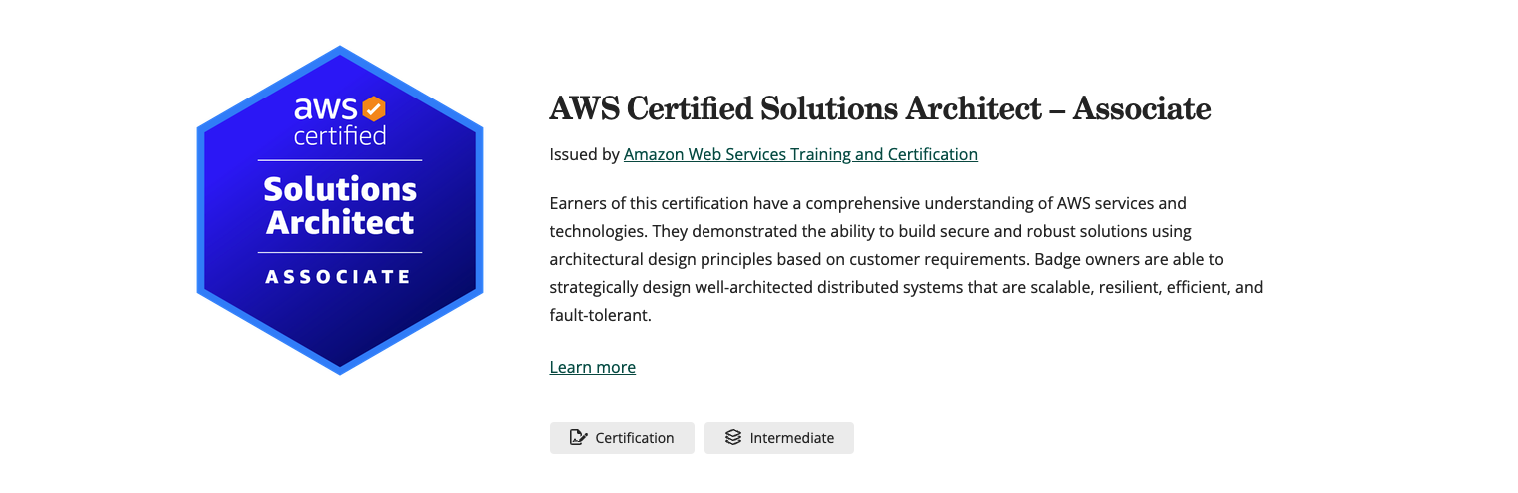
Verify my certification on Credly
Key Takeaways
- Adrian Cantrill's course provides the depth you need - it's worth the investment
- Tutorial Dojo practice exams match the real exam difficulty
- Hands-on experience is mandatory - you can't pass by reading alone
- Study consistently rather than cramming
- Review practice exam explanations carefully, especially wrong answers
- The exam tests understanding and trade-offs, not service trivia
Written by Bar Tsveker
Senior CloudOps Engineer specializing in AWS, Terraform, and infrastructure automation.
Thanks for reading! Have questions or feedback?